
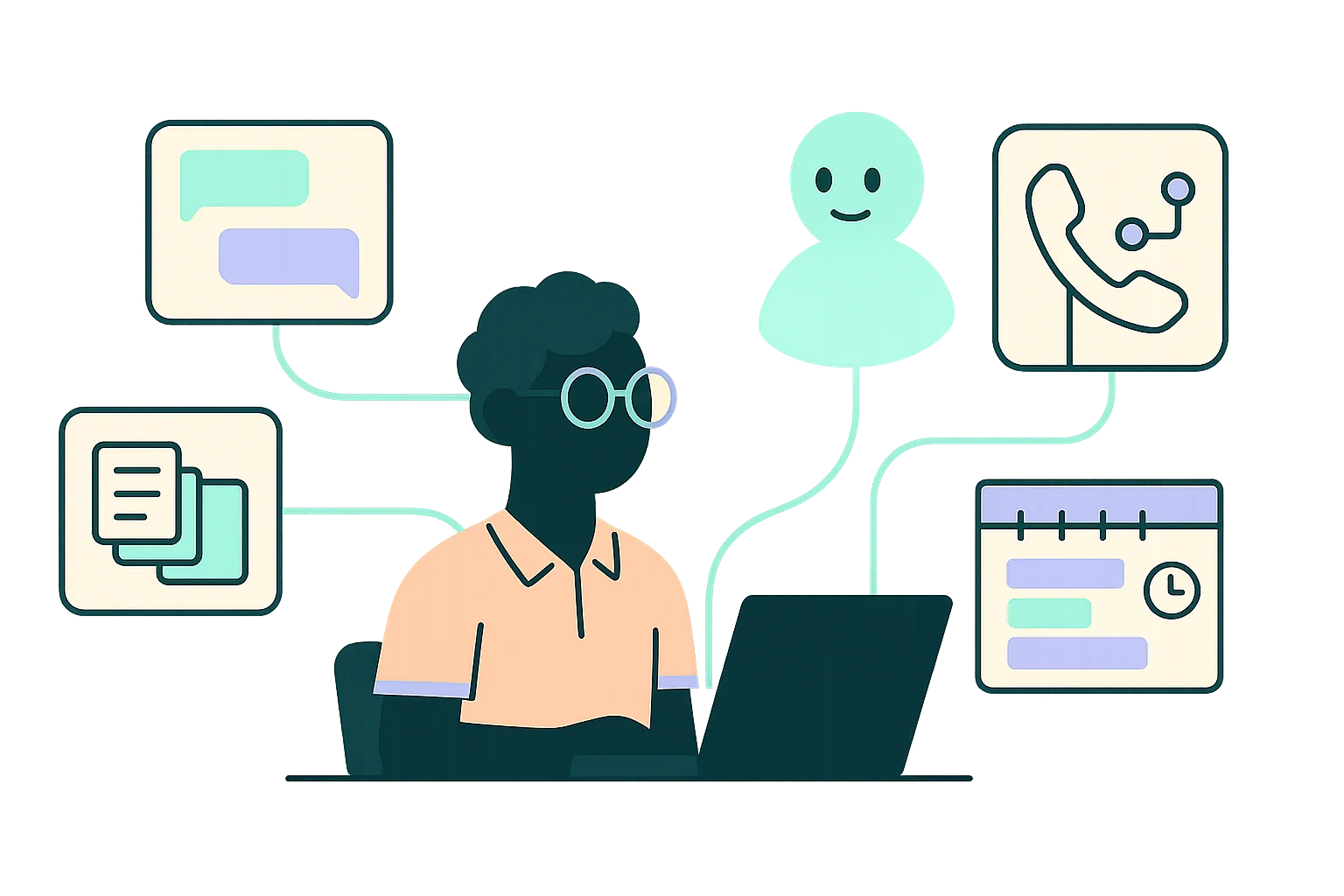
The Complete Guide: AI in Customer Service for SMBs
How AI works in customer service, what it can do, and where its limits are – tailored for SMBs.
Customers expect more than a friendly voice. They want quick answers, continuous reachability, and smooth processes – preferably immediately.
For many small and medium‑sized businesses (SMBs), that’s a challenge. This is where Artificial Intelligence (AI) helps: a smart assistant in the background that saves time and ensures quality.
In this guide, we explain how AI in customer service works, what it can deliver – and where its limits are.
What does AI mean in customer service?
AI in customer service means:
- Standardized, repetitive processes are automated – so your team can focus on what matters most.
Typical use cases
- Call answering
- Appointment booking
- Customer routing
- Answering frequently asked questions
- Forwarding to responsible team members
- Documentation and CRM integration
Why is AI especially interesting for SMBs?
Large companies have entire service teams – small ones don’t. Customers still expect the same standard.
AI levels the playing field:
- 24/7 availability without staffing overhead
- Automated processes without quality loss
- Relief for employees from routine tasks
- Improved response times and customer satisfaction
Where is AI used today?
1. Digital call answering
Virtual assistants like HiDesk answer calls, pre‑qualify requests, and route intelligently – without human intervention.
2. Website chatbots
Simpler requests like opening hours, availability, or services can be answered immediately – around the clock.
3. Callback management
If no one is available, AI schedules a callback automatically – at the customer’s preferred time.
4. Knowledge bases & FAQ bots
Important information is provided automatically – no searching, no waiting.
Benefits: What does AI concretely bring to customer service?
- More reachability: around the clock, including evenings, weekends, and holidays
- Faster service: customers don’t have to wait
- Lower costs: no need to scale headcount
- Consistent quality: standardized processes, no fluctuations
- Less stress for the team: focus on complex requests instead of constant phone duty
Are there risks or limits?
Yes – and it’s important to know them:
- Not a replacement for true conversational understanding in complex or emotional cases
- Technical setup must be implemented cleanly (greetings, routing, privacy)
- Human contact shouldn’t disappear entirely – people still want to reach people
Tip: Think of AI as an addition – not a replacement for all customer contact.
How do SMBs get started with AI in customer service?
1. Analyze calls
- How many calls arrive daily?
- Which topics repeat?
- How much effort does handling take?
2. Choose a pilot area
Start with a clearly scoped use case – e.g., call answering or callback coordination.
3. Select a tool
Look for:
- GDPR compliance
- Easy setup
- Good controllability
- Integration into existing workflows (e.g., calendar, email, CRM)
4. Test, adjust, go live
After a short test run, you can start live operations – with no risk and no commitment.
Conclusion: AI brings advantages – especially for small teams
With AI in customer service, you reach more customers with less effort – building a foundation for growth without overloading your team.
Small businesses benefit the most: you remain flexible, fast, and professional – without compromise.
Try it yourself
Interactive Live Demo
Experience our AI live on the phone
By calling you agree to our Privacy Policy.


Our team is here for you
Book Free Demo
Talk to our experts